Cloud

Avoiding Interdimensional Irrelevance in EPM Cloud: A Smarter Design Approach

When designing an EPM application like Oracle FCC (Financial Consolidation and Close), it’s tempting to try to fit all data into a single cube. We have several system dimensions like Movement and Data Source to play with along with the four Custom dimensions. But forcing data into places it doesn’t belong can lead to a tangled mess of interdimensional irrelevance, hurting both performance and usability.

What Is Interdimensional Irrelevance?

Interdimensional irrelevance occurs when dimensions intersect in ways that don’t make logical or business sense. This leads to sparse intersections, bloated cube sizes, and confusing user experiences. For example, trying to report on a statistical driver against a legal entity that doesn’t use it creates meaningless intersections that slow down processing and clutter reports.

Our Design Challenge

We faced a situation where certain data elements, while important, didn’t naturally fit into the FCC hierarchy. These were supplemental metrics and drivers that were useful for analysis but didn’t belong in the core consolidation structure. Initially, we considered shoehorning these members into the existing hierarchy, but this quickly proved problematic:

  • Adding non-consolidation data to FCC can introduce unnecessary complexity.
  • Sparse data intersections may slow down calculations and retrieval.
  • Mixing supplemental and core financial data risks confusion and misinterpretation.
  • Additional supplemental requirements might create what was coined as a “dumpster dimension”

The Solution: A Supplemental Application

To maintain clarity and performance, I would argue that offloading these supplemental data elements into a separate Planning FreeForm application is a better move. In the on-premises days, we would spin up little analytic cubes all over the place to hold data that really didn’t make sense in a larger cube. I don’t see why we wouldn’t do something similar with EPM Enterprise Cloud customers as well. In my eyes the benefits are:

  • Preserve the integrity of the FCC hierarchy by keeping it focused on core financial data.
  • Optimize performance by reducing sparsity and irrelevant intersections.
  • Enable targeted analysis in the supplemental cube without compromising the main application.
  • Stitch the reporting together in Narrative Reporting and/or ad-hoc analysis with Smart View.

This approach gives the flexibility to design each cube for its specific purpose, while still allowing for integration where needed pushing data through data maps or integrations.

Key Takeaways

  • Don’t force-fit data into hierarchies where it doesn’t belong.
  • Use supplemental applications to isolate non-core data.
  • Design with both performance and user experience in mind.
  • Interdimensional relevance should be a guiding principle in Essbase architecture.

When we respect the boundaries of dimensional logic, we can create cleaner, faster, and more maintainable solutions.

Who moved my Data Integration menu? Embracing change with Setup and Configure

In Dr. Spencer Johnson’s 1998 bestseller, Who Moved My Cheese?, four characters navigate a maze in search of cheese. The book’s main themes are that change is inevitable and that we must anticipate, adapt, and embrace it to be successful in work and life.

Fast forward to the 10.25 Oracle EPM update, and we find ourselves in a similar maze. This time, the “cheese” is the data management Action menu items. And yes, they are about to be moved.

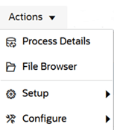
The Data Integration home page has undergone a subtle but powerful transformation. The familiar Actions menu has been reorganized into two new dropdowns: Setup and Configure.

The Setup menu is where you define the structure of your data environment. Think of it as mapping your maze before you start running:

  • Applications: Define your integration targets and sources.
  • Locations: Create and maintain locations for mapping.
  • Period Mapping: Align time-based data across systems.
  • Category Mapping: Manage application scenarios.
  • Query: Setup and modify data source queries.

Once your maze is mapped, it’s time to optimize your tools and security. This is where the Configure menu comes in:

  • System Settings: Control the behavior of your integration engine.
  • Security Settings: Safeguard access and permissions.
  • Agent: Manage the EPM Integration Agent settings.
  • Download Agent: Get the EPM Integration Agent software.

Just like the characters in Who Moved My Cheese? learned to adapt to their new reality, this menu redesign helps users adapt to their data environment more efficiently. By grouping actions based on context, users can find what they need faster and act with greater confidence eventually. Those of us who have switched to using the Data Integration UI will take a little bit to get used to it, but I think this is a small quality of life change that we will come to appreciate.

This update applies across business processes including Account Reconciliation, Planning, Tax Reporting, and more.

In the end, the cheese will always move. The question is: will you move with it?

EDM 25.09 Update – Request Monitoring Dashboard

In the September 2025 udpate (25.09), Oracle is adding a Request Monitoring Dashboard to EDM! Designed to enhance visibility and control over change requests, this dashboard empowers administrators, data stewards, and integration leads to streamline workflows and improve data quality across the enterprise.

The Request Monitoring Dashboard is a centralized interface that allows users to track and analyze open requests throughout their lifecycle. Whether you’re managing metadata changes, hierarchy updates, or complex multi-domain governance processes, this dashboard offers real-time insights into request activity, aging, bottlenecks, and contributor performance.

Key Features:

  • Lifecycle Tracking: Monitor requests by type, priority, workflow stage, and assigned contributors.
  • Custom Filters: Apply and save filters to focus on specific request attributes.
  • Dashboards:
    • Open Requests: View volume and distribution.
    • Active Owners: Identify who’s driving change.
    • Aging and Exceptions: Spot delays and anomalies.
  • Drilldowns & Drill-Across: Dive deep into request details or pivot to related metrics.
  • Export Capability: Download request activity for offline analysis or stakeholder sharing.
Request Monitoring Dashboard displaying open requests, active owners, aging, and exceptions. Features include request count by stage, open request distribution by application, and a snapshot of outstanding requests.
Sample Request Monitoring Dashboard image courtesy of Oracle

Why It Matters:

Managing change requests efficiently is critical to maintaining data integrity and operational agility. The dashboard helps teams:

  • Reduce request cycle time
  • Identify and resolve workflow bottlenecks
  • Improve exception handling
  • Enhance collaboration across business units

The Request Monitoring Dashboard isn’t just a new feature—it’s a strategic tool for proactive governance. By surfacing actionable insights and enabling smarter oversight, the Oracle EDM dev team continues to raise the bar for enterprise data management.

To find out more about this release, see the August 21 Oracle EPM Event by Rahul Kamath and Matt Lontchar here: https://community.oracle.com/customerconnect/events/606792-epm-whats-new-and-whats-coming-in-oracle-enterprise-data-management-edm-cloud

The EDM 25.09 features list can be found here: https://docs.oracle.com/en/cloud/saas/readiness/epm/2025/edm-sep25/25sep-edmcs-wn-f40991.htm

UPDATE: TLS 1.2 Deprecation Testing

After the 25.06 update was released, I did a quick test of a Windows 10 VM with Smart View and EPM Automate. The concern was that TLS 1.3 is supported only on Windows Server 2022 and Windows 11 and that our customers on older versions of Windows may have issues.

The test consisted of a Hyper-V Windows 10 Enterprise Evaluation VM with MS Office 365 installed. Using a test pod with the Vision Planning sample app installed, I tried to get in and start testing around 5:30 PM CDT (22:30 UTC) but the update wasn’t pushed yet. I tried a couple of times to run the “epmautomate rundailymaintenance” command to force the update, but no luck. After 6:00 PM CDT, I tried the rundailymaintenance again and it worked.

My Smart View ad-hoc template retrieved data just fine. Similarly, EPM Automate logged in after the update and told me it needed an upgrade. I ran the upgrade command and logged out. Even after the upgrade, EPM Automate logged in just fine.

Looks like a big nothing burger, which is the best result for us all. This was a test of end user tools, so I would still recommend all of you out there in EPM land to thoroughly test after this update just to make sure everything is good.

The coming TLS-pocalypse?

On Friday, June 6, 2025, the June (25.06) update will be released. Since at least April, Oracle has been communicating that TLS 1.2 will be deprecated in favor of TLS 1.3. Transport Layer Security is used to encrypt data transfers between computers, like between your company laptop and the Oracle EPM Cloud server. TLS 1.3 has stronger encryption algorithms to safeguard that data so it makes sense that we need to update to the later standard.

Browsers have supported TLS 1.2 and 1.3 for quite some time, so no worries there. There is some ambiguity in Oracle’s statement that causes me some concern, though. In the June Update, we have the following:

Transport Layer Security (TLS) protocol version 1.2 is no longer used for connections to Oracle Fusion Cloud EPM environments; all connections are made over TLS 1.3 only. This change requires you to use a browser that supports TLS 1.3. Additionally, you need to ensure that the operating system and EPM Clients (such as EPM Automate, Smart View, and EPM Agent) that you use support TLS 1.3. The newest version of EPM Clients, and many previous versions, already support TLS 1.3.
If you integrate on-premises EPM instances with Fusion Cloud EPM using Financial Data Quality Management Enterprise Edition (FDMEE), make sure to use FDMEE version 11.2.7 or newer because older versions do not support TLS 1.3.

Over the last 15 years, I think 80% or more of my work at customers has been done on Windows client machines and servers. Many times, customers have implemented their corporate standard OS version which might not be the latest available at the time of installation. Given that information, the third sentence of the Oracle Update notes seems to indicate that the OS also needs to support TLS 1.3.

After searching on some Microsoft sites, it seems that the only flavors of Windows to support TLS 1.3 are Windows 11 and Windows Server 2022. The concern is that customers who sometimes are a little slower to adopt new technology may experience issues trying to integrate with EPM Cloud products if they are on Windows 10 or older Windows Server versions that don’t support TLS 1.3. Customers who use FDMEE on-premises instead of the EPM Integration Agent still will also want to ensure their FDMEE has been upgraded to at least 11.2.7.

We will see what happens Friday night. Hopefully it’s as non-eventful as my New Year’s Eve in 1999.

Kim Kardashian can get my Essbase server updates

I had the great pleasure of presenting at Kscope17 on the power of Essbase CDFs.  At the end of my CDF presentation this year, I gave a live demonstration of a little CDF that is designed to spark the imagination.

In 2009, Matt Milella presented on CDFs at Kaleidoscope and talked about the top 5 CDFs that his team had created.  At the end, he showed a very cool demonstration of how his Essbase server could send out a tweet using a CDF. This was an amazing display and really inspired me to figure out how to create CDFs.

So, as an homage to Matt’s blog post about how Ashton Kutcher can get his Essbase server updates, I have created an updated version of the Twitter CDF. As Matt states, he used JTwitter back in 2009.  Unfortunately for me, Twitter has long since changed their authentication to use OAuth for security which means that JTwitter doesn’t work anymore.

I did some searching and found Twitter4J, an unofficial Java library for the Twitter API. This library handles the OAuth authentication as well as allows submitting of new status updates, sending direct messages, searching tweets, etc. Between Matt’s original Twitter code, the Twitter4J sample code, and some trial and error, I was able to get the library setup and created a Java class that could send my tweets.

  1. The first step was to download the Twitter4J library.  I added the twitter4j-core-4.0.3.jar file into my lib folder in JDeveloper and added it to my classpath.
  2. Next, I had to setup a new Twitter account (EssbaseServer2).
  3. Then, I went to http://twitter.com/oauth_clients/new and setup my application to get the OAuth keys needed for my code to authenticate.
    TwitterApp
  4. Once I gathered the keys, I put them into a .properties file called “EssbasTweet.properties”.  This file will be placed onto my Essbase server into the %EOH%/products/Essbase/EssbaseServer/java/udf directory.  Placing the file into the …/java/udf directory puts it into Essbase’s Java classpath and Essbase will be able to access the file when its needed.
    propertiesFile
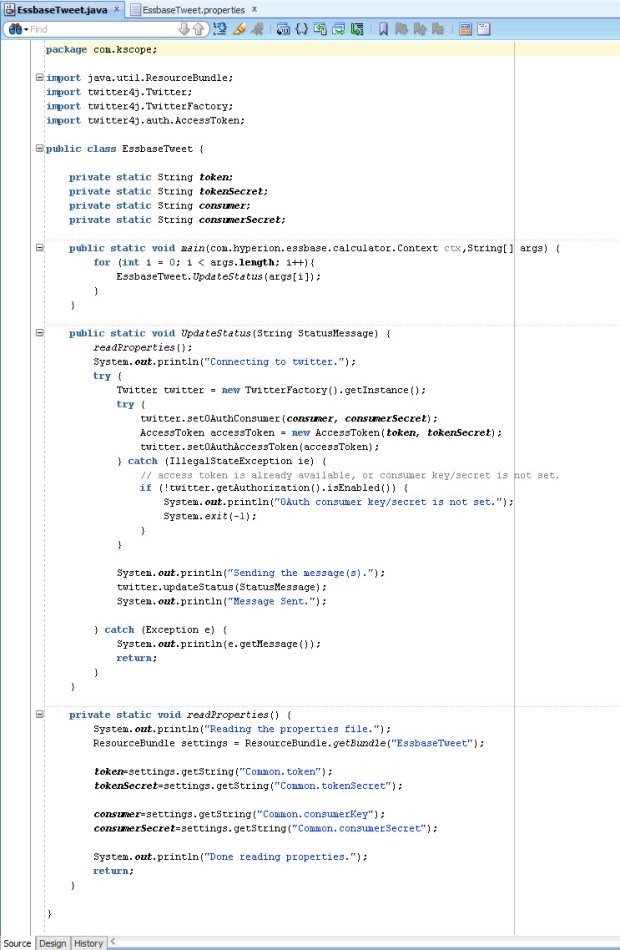
  5. Next, I wrote my code (based heavily on Twitter4J’s sample code), compiled it, deployed the code to a JAR and placed the JAR on the Essbase server.
    SourceCode
  6. I registered the CDF manually in EAS.
    RegisterCDF
  7. I was able to pretty much reuse Matt’s original calc script as he had it back in 2009 with the exception of using an @CalcMgr function instead of one of the older data functions.

Does it work? Well, go and check out the @EssbaseServer2 account for yourself.

While publicly tweeting your data might not be the best idea, hopefully this serves as a spark to ignite your imagination of the power of CDFs. Anything you can do in Java can be implemented in an Essbase calculation. Some attendees of my presentation were pretty excited about the possibilities of communicating with their users by submitting messages using Slack or updating a status on a SharePoint site. The possibilities are limited only by your imagination.

Thanks again to Matt for presenting on CDFs eight years ago. It definitely inspired me to learn more and hopefully this will inspire others to do the same.

There has been some uncertainty about the fate of CDFs with OAC and the Essbase cloud service, but never fear, CDFs are supported but they are limited to local CDFs. More on that in the future.

OAC Backup issue

I have found myself between projects for a couple of weeks which has given me a great opportunity to get hands-on with interRel’s OAC instance. It has been great to crawl around it, kick the tires, and get my hands dirty under the hood, so to speak.

One of the things we had issues with was running a backup at the service level. In OAC, there are two types of backups – service level and application level. The service backup is a full backup of all the runtime artifacts required to restore the service, such as the WebLogic domain, service instance details, and any metadata associated with your service. Basically, it’s like a snapshot of the VM that gets saved to your cloud storage instance (one of the prerequisites of OAC).

As I was playing with OAC and trying to figure out how to administer the product, I noticed that a monthly patch was available. Before applying the patch, I decided to take a service backup just to be safe in case anything happened during the patch.

From the OAC dashboard, I selected Administration. Then on the backup tab, I selected Backup Now.

OAC Backup Now

After 30 minutes or so, I came back to find out that my backup had failed. I attempted to run the patch anyway, but it does a backup first as well and so it failed again.

Eventually, I ended up submitting an SR with Oracle for help. Within about an hour or so, Oracle Support determined that it was likely that when we created our OAC database cloud instance that the USERS tablespace was not created.

My friend and co-worker, Wayne Van Sluys (http://beyond-just-data.blogspot.com/), ran into this issue at one of our OAC clients as well. Wayne sent over the information that I needed to get connected to our DBaaS instance via Oracle SQL Developer.

When you create an OAC service, one of the prerequisites is setting up the DBaaS service. The connection information you will need is accessible from the Database Cloud Service console. The Public IP address and connection string on the Service Overview page gives you what you need to know along with your “sys” schema name and password.

DBaaS connection info

In addition to this information, you also need to edit the Access Rules for the DBCS service to allow connections from outside on port 1521. I enabled this Access Rule for the service while I made the change.

DBaaS access rules

In SQL Developer, I was then able to set up the connection to our DBCS instance.

SQL Developer connection

With the connection made, I could then submit the SQL code to add the USERS tablespace using the “CREATE TABLESPACE” command. I will leave it to the reader to consult a DBA on the command and what options you should supply with the command.

After creating the USERS tablespace, the backups are now running successfully and I was able to apply the latest patch to our OAC environment.

Success

Success!

Do Oracle’s OOW cloud announcements signal the death of on-premises EPM?

This week at Oracle Open World, Oracle has announced more details around a few new EPM Cloud products (Essbase Cloud Services, PCMCS, and DMCS) in addition to their already existing stack of SaaS cloud services (PBCS, EPRCS, EPBCS, ARCS, and FCCS).
axeWith these new offerings added to their stable, is this the death of on-premises EPM as we know it?

Oracle’s stated direction of product strategy for the EPM products is to tap into unserved business users. EPM has been predominantly used by corporate finance departments from the beginning. At one point, Hyperion was marketed to CFOs and not CIOs because it could be run on an administrator’s computer under a desk without IT involvement. The evolution of EPM cloud is a return to the golden age of Essbase – easily created departmental applications that provide better analytic ability than Excel alone.

The EPM cloud products are really all about allowing easy adoption for non-traditional EPM users and providing rapid value to their customers. Spreadsheets still dominate at small to medium companies. The cloud offerings are really simplify life for those companies who struggle with maintaining servers and have a lack of technical skill at designing an optimized solution. With the EPM cloud products, it’s very easy to roll out a Workforce or CapEx application in EPBCS by sending out the URL and paying the monthly subscription fees. The cloud also allows the business users to be in the driver’s seat by not needing IT resources to get them up and running.

As we know, there is a long way to go yet on the EPM Cloud roadmap to get all of these products working well together. For instance, how exactly do we get data from our EPBCS application into ESSCS for additional reporting? How about my BICS dashboards using data from my ESSCS departmental cube or my PBCS budget data? It’s clear to see that with Oracle’s growth in the cloud and continued development of additional features and functions on the cloud products that these drawbacks will be remedied in time.

This whole cloud thing is just a fad, it will pass, right?

Even Mark Hurd stated during his keynote on Monday that the cloud is no fad, it’s a generational shift that is here to stay. Oracle has stated publicly that they fully intend to continue to support and develop EPM on-premises solutions. Matt Bradley, SVP for EPM and BI Development at Oracle, has said that Oracle expects most companies will enter into a hybrid cloud implementation if and/or when they decide to move their investments into the cloud. They have developed tools in DRM and FDMEE to support these hybrid cloud implementations. The shift to cloud computing is happening, but it doesn’t signal the immediate end of the line EPM on-premises. Once the cloud products have fully matured, there may continue to be valid use cases for on-premises EPM products going forward.

So, what is the future of my on-premises investment?

The market indicates that there is a healthy appetite for cloud solutions and all indications are that Oracle expects even large customers to eventually move their EPM investments to the cloud. While the on-premises products are still being developed, the availability of new on-premises versions has slowed down. For the last few years, we were blessed with several major releases of EPM software from 9.3.1 to 11.1.2.4. Oracle noted that the software release adoption cycle was about every two to three years, so we expect that the new software releases for on-premises will be more in line with those adoption cycles. We should expect to see some new features and functionality through Patch Set Updates to the latest code line in between major upgrades. Future on-premises releases will begin to showcase a simpler architecture to the components and focus on usability.

What should we do with our on-premises EPM environments now?

If you haven’t already upgraded to version 11.1.2.4, it is highly recommended. The 11.1.2.4 code line has some great features like better support for Essbase Hybrid Aggregation, improvements in HFM consolidations, FDMEE data synchronization between EPM applications, and the new Financial Reporting Web Studio. I have been on several calls with customers who are still working in old releases and the Classic Essbase add-in. It is time to move on and update those environments. If you have upgraded to version 11.1.2.4, it’s highly recommended to keep up with the latest Patch Set Updates on at least a quarterly basis. Sometimes applying the latest patches may cause some issues, so thorough testing of new patches is always recommended before implementing into production.

Staying on the latest release also allows companies to bridge from on-premises to cloud much easier. For example, as mentioned earlier FDMEE and DRM already support hybrid cloud implementations. Oracle has doubled-down at OOW 2016 on their assertion that cloud computing is the future. While on-premises EPM software isn’t going away any time soon, the cloud products are going to continue to mature rapidly. As the cloud products develop and integrations between them become more defined, more and more companies are going to see the benefits of moving their EPM investments into the cloud.

The times they are a-changin’

Collaborate ’16 has come and gone. I was fortunate enough to be able to join in on Monday of the conference for the OAUG Hyperion SIG meeting. As part of the conference, I was able to join a couple of road map sessions and speak directly with Oracle EPM marketing folks; it is clear that we are in the midst of change.

To be clear, I do not mean to directly equate today’s technological shift with the political, social, and cultural upheavals of the early 1960s. To do so would be a slap in the face to the many heroes of the time, especially those that gave their lives for equality. Bob Dylan created an anthem of change and expressed his feelings in generalities that can fit many circumstances. That is what makes his song relevant for so many even today.

I was recently watching a webcast replay by Joe Aultman, a guy who I really respect and consider a friend, about Essbase and whether it belongs under the control of IT or the business. Joe gave this presentation live during KScope 15 for those lucky enough to be there. During the presentation, Joe went through an excellent history of Essbase.  He spoke about how it started as a tool that was sold to Finance and sat on a server under someone’s desk at many companies. How exciting those early days were.

I have been working with Hyperion directly for more than ten years. Before that, I worked closely with the Hyperion Enterprise administrator and he showed me a few things so I could back him up. We ran Enterprise on a Citrix server, but we pretty much had full control of the box with very little IT intervention at all. It was fantastic! Thankfully we didn’t ever need a whole lot of help with that environment.

About a year later when I started with Essbase, a co-worker showed me how to install Essbase 6.5.4 on my desktop so that I could play with an outline to replace that old Enterprise application. Our installation in production was version 9.3.1, though. We had IT to manage our servers now. I had to practically beg to get a batch script scheduled on the server for nightly backups of our data.

With the complexities of the EPM System today it’s hard to imagine anyone implementing Essbase without IT support. With Oracle’s EPM and BI Cloud Services, what’s old is new again. Departmental applications can once again flourish as the Enterprise Planning Cloud and the upcoming Essbase Cloud Service offerings reduce the rigidity of IT and allow the business to control their applications.

There is no doubt that Oracle is making a strong push for customers to join the cloud revolution. That push is strong enough to make infrastructure consultants like me who are heavily reliant on the on-premises software model take notice. So, what is an infrastructure person to do? Diversify.

Luckily, I started in Hyperion with an application background. I learned Essbase inside and out at Wells Fargo Home Mortgage, then I went into consulting and learned Planning, FDM, ODI, infrastructure, OBIEE, enough to be dangerous in HFM, FDMEE, etc. I think the real sweet spot for developers like me is in data integration. The technology will keep changing, but we are always going to need to move data from one application into another.

As the underlying technology changes, this blog must also change to reflect the current trends and hopefully help anyone who stumbles across this site. Honestly, this blog was never about one particular thing. While I have primarily focused on infrastructure, there are a lot of areas in the EPM and BI world to be explored.

Come gather ’round people
Wherever you roam
And admit that the waters
Around you have grown
And accept it that soon
You’ll be drenched to the bone
If your time to you
Is worth savin’
Then you better start swimmin’
Or you’ll sink like a stone
For the times they are a-changin’.

-Bob Dylan, The Times They Are a-Changin’, 1964

RedCloud