Cloud

EDM AI Change Assistant Part 3: Return of the Admin

Over the last couple of posts, we walked through what the EDM AI Change Assistant is, how it can be helpful, and seen some of what it can do so far. If experience has taught us anything, it’s that Oracle will continue to develop the tool and add additional features over time. I think the important thing to note is that the value of governance hasn’t decreased because we have AI to help out. If anything, I think it makes governance more important.

The assistant makes it easier to find your nodes, build queries, and create request items using prompts. Some of the careful clicking and dragging will hopefully be a thing of the past which is a fantastic improvement for admins and users.

But, as we saw in the last post, the AI Change Assistant doesn’t take credit or assume responsibility for the change, that’s on you. It’s not about whether the assistant can build a request, the question is whether that request is correct and/or should be submitted at all. That’s where having a human-in-the-loop is essential.

Hide the Pain Harold MemeBack to governance for a second, if I can ask the assistant to make a bunch of changes and not review each one carefully that’s an open window for garbage to enter your system. If anything, I’ve learned that it’s going to be more important for us to start adding in additional custom validations to ensure that the business logic that lives in our heads is actually present in the system. This is the only way that we can flag when a user has given AI an incorrect prompt and violated a numbering sequence or naming convention.

While EDM contains data (metadata), it doesn’t know what humans do about the organizational politics or any future reorganization plans. Human reviewers bridge that gap. The last thing we want is AI to blindly accept what a user is asking it to do and/or humans allowing the system to arbitrarily make those changes without review.

Human-in-the-loop is a feature, not a bug. It’s exactly how the system should work to maintain integrity especially with your organization’s master data.

The Change Management Assistant is a significant step forward toward allowing administrators to spend less time constructing requests and more time evaluating their impacts. EDM has always been about managing change in a controlled manner. The arrival of AI doesn’t change that, it simply makes the need for human oversight and governance controls built into the system even more apparent.

EDM AI Change Assistant Part 2: HAL Strikes Back

Last post we covered what the EDM AI Change Assistant is and how it can help less technical administrators. Let’s face it, most people who work in EDM day-to-day aren’t doing that as their sole function in the business. Most likely, they are administrators for multiple financial applications and have many responsibilities beyond just getting the metadata correct each month. Join me while we see what this assistant, who I lovingly referred to as HAL, can do with some practical examples.

One thing to keep in mind when you are starting your conversation, try and keep your context clean each session. If you hide the chat window, it will retain where you left off from your conversation. If you pick back up and need to do something different, use the little eraser icon to reset the context.

As I mentioned last time, if you haven’t already enabled the Generative AI features, you will need to do that first before you can use my pal HAL. To do that, log into your EDM instance and navigate to Tools>Settings. Here you will want to check the box under Generative AI. Oracle doesn’t have this turned on by default, you must opt in. Before you do this, you may want to make sure that your IT security team has blessed using these tools with your company’s data.

Navigate to your choice of Viewpoints. Here I am using the wonderful Oracle sample EDM application. By the way, I want to give a huge THANK YOU to the Oracle team for allowing us to create an instance that has stuff pre-built. It’s a huge help when I am trying to do this kind of stuff or show a new customer how EDM works. But I digress, the sample application has plenty of viewpoints to choose from and more applications built than you can shake a stick at.

I started out in the Account Maintenance view because it has ERP and FCC viewpoints. I thought this might be a typical place to start for most administrators. I figured we may as well start with the most basic question, “What can you do?”

Here are some practical hands-on examples that an administrator might run:

  • Show me details and history for Entity C_305
  • Set Account Type = Expense for all accounts containing 6
  • list members with “x” in the name

As I played around, I took some screenshots to try and show the types of responses you can expect.

This slideshow requires JavaScript.

One of the above examples, I purposefully tried to give the system a prompt that I knew would result in a validation error. Old HAL went along with my request and sure enough, reported the error to me. I also tried to feed it a misspelled prompt to see if that would throw it off, but it knew what I was trying to do.


Each of my requests was done in the same viewpoint and the request items built upon each other. Each query built a new viewpoint query on the side and then created a spreadsheet of request items to add to the open request.

If the assistant can’t understand your intent from the original prompt, it will ask additional questions to refine the selection.

As I played with the assistant for a couple of hours, I learned a few things that I can pass along:

  1. The assistant can’t create new requests on its own. A user must open a new request, and then the agent can add request items to the open request.
  2. Security and governance are still enforced. If a delete action can’t be performed on a viewpoint, the AI assistant can’t add a delete request item.
  3. As the AI thinks, it sends back a little log that gets collapsed. You can use the carat icon to expand the details and see the steps the AI took to get your result.
  4. The assistant is helping YOU make the request, all of the changes are attributed to your user ID so be careful.
  5. While this assistant has guardrails, it did give me some information when I posed a design question which was interesting. The Oracle FAQ on the assistant notes that it’s not intended for creating node types or other admin functions that aren’t currently documented.
  6. It can’t do comparisons yet. You’re pretty much limited to building a node list with a query and then doing request actions against the query items.
  7. You can take a hybrid approach. Maybe you open a request, tell the bot to do a few things and then finish up manually.
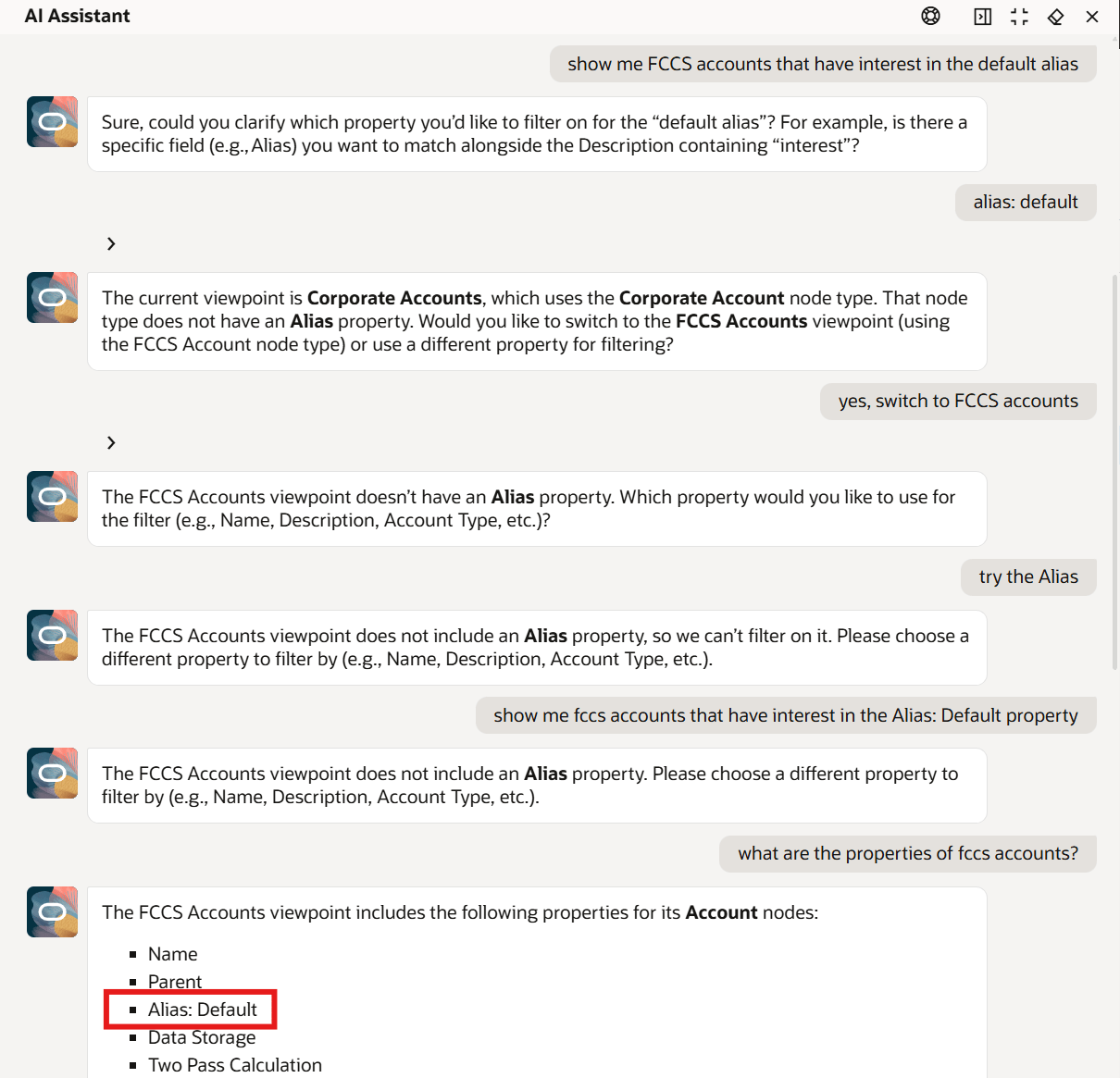
  8. I had better luck getting the AI to recognize the property names when I put them in quotes. Maybe that was just me, but it wouldn’t understand Alias: Default until I told it ‘Alias: Default’.
  9. When you’re querying nodes with the assistant, there are specific properties that are and are not indexed for searches. You can find those indexed properties with the little “one to many” symbol next to them in a viewpoint query as below.

To wrap things up, if you’ve mastered the UI and are an EDM expert this probably isn’t the tool for you, yet. I can whip up a Excel sheet with request items a lot faster than I can refine my prompts well enough to do any bulk updates. The power of being able to search nodes a little bit better is promising so I may keep playing a little bit.

The Oracle EDM product team didn’t just come up with a chatbot for EDM, they really built a different way to enable users to query nodes and create request items to work with the properties. All of the governance and security remains intact, the assistant is there to help users do those actions based upon the instructions the user provides.

Just because the assistant helps to build a technically correct request, that doesn’t mean that it’s an appropriate request. My buddy HAL doesn’t know your organization’s politics or policies or data ownership boundaries. It just knows the instructions that you gave it and checks that against your security and validations. I think the most important skill isn’t how to engineer your prompts better, it’s knowing that you are responsible for reviewing what you’ve just told the system to do. We will explore that topic more in the next post.

The EDM AI Change Assistant: What It Is and Why It Matters

This will be a three part series covering the EDM Change Management Assistant. I was able to see a demo of this in action and it really changed my opinion on how useful it can be for administrators.

The past several years, working in EDM meant mastering the user interface; knowing the various shortcuts to jump to the screen that you want to be in, where to click, and how to build your request just right. With the Change Management Assistant, some of that knowledge won’t be used as frequently. Instead of navigating, you can just describe what you want.

The Change Management Assistant is a gen-AI chat interface that you can find in your viewpoints. Just click on the “Ask Oracle” button to get started. With this feature you can query nodes, explore metadata, generate and modify requests, perform bulk updates, and ask questions about requests all using natural language. If you don’t have this button, be sure you have enabled the AI features

When I first played around with this feature, I was only interested in finding nodes by their alias. As you may know, the search feature in EDM is not always super helpful when you’re looking for an account with “interest” in the alias. So when I tried a similar search with the Change Management Assistant (that’s a long name that I don’t want to keep typing, so let’s call it HAL) it didn’t bring back what I wanted and I threw up my hands and gave up. I didn’t realize that it could be used to build requests or do some of these other things, so I wanted to give you all a friendly bit of encouragement to keep trying it if that also happened to you.

Apparently, I still have some work to do to figure this thing out.

“HAL” isn’t just a convenience feature, it makes EDM more accessible to business admins. And those less technical admins are really the true audience of EDM.


So, what’s going on under the covers? “HAL” is actually dynamically building viewpoint queries based on your conversation. It also has the ability to build requests based on your asks. Once the assistant has created a request for you, it’s possible to jump out of the chat and refine the request manually. The other important thing to note is that this feature currently needs a human-in-the-loop to validate the request and submit it. Perhaps at a future date, we can have the assistant submit requests on our behalf, but for now, it’s safer to double check before letting the AI make hierarchy changes on its own.

Like the other Gen AI feature I mentioned in the last post, there is a prerequisite to enable AI features before you can use the assistant. There are some other guardrails on this feature to be aware of:

  • Permissions still apply – the assistant isn’t going to make any request changes that the user doesn’t have permissions to do themselves
  • English-first experience – in this early iteration, English is supported but “HAL” may respond in other languages depending on your user preferences Language selection
  • AI assistant won’t submit requests, yet

Despite my dated references, “HAL” is an assistant; it’s not autonomous. It’s not going to lock you out of the pod bay doors, as an admin you still have full control. And if you haven’t seen Kubrick’s “2001: A Space Odyssey,” none of that makes any sense to you.

Now that we have covered what the “Ask Oracle” button is all about and what it’s used for, the next post will go into some practical usage examples hopefully with some great success.


Testing out EDM’s GenAI Feature

Oracle continues to add AI to its SaaS offerings including Oracle EPM products. They have been releasing AI features since 2024. Just to recap on some of the EPM AI features currently available:

  • IPM Insights to generate a narrative summary on an insight or group of insights
  • PCM Agent to assist with workflow tasks
  • Narrative Reporting generative AI features for commentary within report packages
  • Advanced Predictions in Planning and FreeForm
  • Predictive Cash Forecasting
  • As of the 12.25 release, Oracle added the EDM application registration assistant to generate properties

I had a chance to test drive the EDM GenAI feature while building a prototype for a customer recently and it is amazing. This is my “Tom Cruise on the couch” moment for EDM.

<EDIT> I didn’t realize that was over 20 years ago, so some people may not get that reference. Please see https://knowyourmeme.com/memes/tom-cruise-jumps-on-oprahs-couch.

What’s the big deal?

If you’re not setting up a new application and are in maintenance mode in your applications, maybe you don’t even care about this update. But, if you’re prototyping a new app or thinking about expanding your EDM application into other master data domains like products, customers, vendors, things like that, this update saves a ton of time.

Building a custom application can involve some tedious work. Setting up each and every property takes a couple of minutes; you have to enter in the property name, identify the data type for the property, etc. But, with this generative AI application registration assistant, it can evaluate a .csv file of a bucket load of properties and the first 10 rows of data to identify the property names and data types for you. This came in handy for me with a customer’s data set that had 173 properties.

Enable AI

To get started using Generative AI in EDM, the first thing you need to do is enable the feature in the application Settings. Just check the box. No restart of the service is needed. That’s literally all there is to do.

Now that AI has been turned on, you’d expect some confetti on the screen or something, but nothing.

Is this thing on?

So, now that we have enabled AI how do I use this feature? Oracle’s docs say:

To generate properties using a sample file, you must be on the Properties for Dimension Node Type page. You access this page when you perform any of the following tasks:

Maybe it’s my midwestern, plain-speaking roots or something, but I couldn’t decipher that. So, my next step was to try and play with it to figure it out.

I went into the Node Type and played around in there with properties but didn’t see anything different.

So, I tried to add a new Node Type from the Node Type card in the Information Model, but that didn’t allow me do anything different in the Properties window either.

Then, I went into the application by selecting Modify Registration and navigated into my Node Type that I was trying to edit.

Success!

I already gathered a data file with electric vehicle data (thanks Uncle Sam), so with that file in hand, I clicked on Generate to add my custom properties.


I clicked the “Drag and Drop” button and it allowed me to browse to find my EV file. The GenAI assistant reads the headers and the data rows to determine the Property Name and Data Type as well as suggest what level (Node or Relationship) the property should have. If you don’t like what it selected, click the Edit button to change the values.

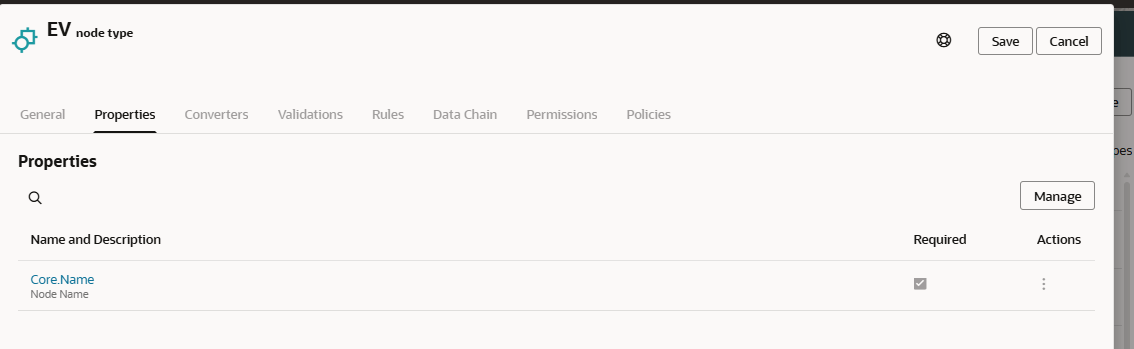
In my case, I wanted my VIN property to be the Name. I tried to tell the application this is my Name, but as you may have noticed in the earlier pictures, the Name property already exists. In this case, I used the Actions “delete” icon to remove that property.

Next, I noticed things like Postal Code and Model Year were set to Integer. I didn’t want the system to try and put commas as thousands separator in those fields, so I changed them to Numeric String. Of course, with any AI usage, there should be a human in the loop to ensure that AI is handling things properly.

After clicking Save, and finishing up my Modify Registration wizard, I could see the properties were built in my Node Type.

Lessons Learned

File preparation can go a long ways in saving you time fixing some AI mistakes here. You want to have 10 or so rows of sample data so the system can determine the Data Type and Level for the properties. Your headers should be labeled how you want them to appear in EDM and you can specify your property order in the file as well. Adding prefixes to your properties and clustering them together might make it easier when you create property groups as well.

As you can see, this GenAI feature is assistive, not automation. It provided a great deal of time savings to me as a developer, but I can’t blindly trust the system to choose the correct data types for each property. This feature accelerates setup, but doesn’t replace design. It’s still important to define naming standards as you can see with the long names from my data file.

While this is dramatically faster than building all properties from scratch, we still need to plan for multiple refinement cycles and time to adjust those AI-generated properties.

This new GenAI assistant is ideal for new applications or domain onboarding in EDM. This could help out with new implementations, when doing M&A activity, re-platforming enterprise data, or metadata rationalization projects.


Oracle EDM team drops a massive amount of updates for the 26.04 release

With the first calendar quarter of 2026 in the books, Oracle is ready to resume the monthly update schedule for EPM applications. Since we haven’t had a normal update schedule for a few months, the EDM development team has a backlog of updates that will finally be automatically pushed this month. The descriptions of the features are on Oracle’s site and you can find that link at the bottom if you haven’t seen it already.

Spotlight Features:

In the EDM list of spotlight features from Oracle we see the following:

  • A generative AI assistant is now available within Universal application registration to quickly create and configure properties for node types based on sample data files.
  • Hierarchy viewpoints can now be optionally visualized in an organization chart format rather than the standard tree format used by default.
  • Global connections can now be defined to Microsoft Azure Blob Storage in order to share data with external applications and processes from a centralized storage location in a Microsoft Azure cloud environment.
Gen AI Assistant:

This sounds like a very cool feature to help speed up the development process. My take is that EDM build phases can sometimes be a little tedious with all of the clicks needed to wire things up correctly, so this is a good first start to try and streamline that process. This is obviously a first iteration, so I’m excited for the future when you can just point EDM to an FCC or Planning application and have the AI assistant read the dimensionality and then you can choose which dimensions to set up in EDM. On top of that, just imagine you can say to an AI assistant, “I have this ERP system here’s a file with my segments. Here’s the URL for my EPM application. Build two EDM apps for the metadata management and create a mapping viewpoint to manage the data integration maps as well.”

Viewpoints in Tree format:

I have seen this functionality and I am used to seeing things in the default visualization so that makes more sense to my brain. I’ll have to play around with the tree view to see how useful it will be for me.

Azure Blob Storage connection:

Azure Blob Storage connection is a great addition. This especially makes sense as more and more organizations are seeing the benefit of using EDM for non-financial domains. At a prior employer, we were mastering employee roles that were fed into Azure Blob Storage which eventually fed HR systems. The ability to send an extract direct to Azure Blob Storage will streamline that process and make some of the automations created using EPM Automate and WinSCP unnecessary. It will streamline the integrations which is a win in my book.

Other Updates:

New Validations for FCC applications:

There are some new validations that will be added to FCC applications for the Account dimension. These will be enabled by default on new EDM FCC applications, but need to be manually enabled on existing applications. These will replace some custom validations that customers have created. It’s great to see that some of the features that customers have asked for in the Cloud Customer Connect Idea Lab coming into reality.

Address verification:

When importing addresses, customers with Oracle’s address verification service can ensure that good addresses are loaded into EDM from the beginning. Data cleanliness is very important when mastering Customer or Supplier dimensions, so this is a great addition to the product.

OAuth2 Authentication for Oracle cloud ERP and Financials connections

OAuth token based authentication is preferred for most IT shops since it doesn’t require maintaining a password. This is great news that token authentication is being implemented more and more across the Oracle stack.


Of course, these are just my opinions. If you have a different perspective, I’d love to hear it. Sharing knowledge is one of my core values and as the saying goes, a rising tide raises all boats.

References:

Oracle EPM April 2026 What’s New: https://docs.oracle.com/en/cloud/saas/readiness/epm/2026/epm-apr26/26apr-epm-wn-f44078.htm


Avoiding Interdimensional Irrelevance in EPM Cloud: A Smarter Design Approach

When designing an EPM application like Oracle FCC (Financial Consolidation and Close), it’s tempting to try to fit all data into a single cube. We have several system dimensions like Movement and Data Source to play with along with the four Custom dimensions. But forcing data into places it doesn’t belong can lead to a tangled mess of interdimensional irrelevance, hurting both performance and usability.

What Is Interdimensional Irrelevance?

Interdimensional irrelevance occurs when dimensions intersect in ways that don’t make logical or business sense. This leads to sparse intersections, bloated cube sizes, and confusing user experiences. For example, trying to report on a statistical driver against a legal entity that doesn’t use it creates meaningless intersections that slow down processing and clutter reports.

Our Design Challenge

We faced a situation where certain data elements, while important, didn’t naturally fit into the FCC hierarchy. These were supplemental metrics and drivers that were useful for analysis but didn’t belong in the core consolidation structure. Initially, we considered shoehorning these members into the existing hierarchy, but this quickly proved problematic:

  • Adding non-consolidation data to FCC can introduce unnecessary complexity.
  • Sparse data intersections may slow down calculations and retrieval.
  • Mixing supplemental and core financial data risks confusion and misinterpretation.
  • Additional supplemental requirements might create what was coined as a “dumpster dimension”

The Solution: A Supplemental Application

To maintain clarity and performance, I would argue that offloading these supplemental data elements into a separate Planning FreeForm application is a better move. In the on-premises days, we would spin up little analytic cubes all over the place to hold data that really didn’t make sense in a larger cube. I don’t see why we wouldn’t do something similar with EPM Enterprise Cloud customers as well. In my eyes the benefits are:

  • Preserve the integrity of the FCC hierarchy by keeping it focused on core financial data.
  • Optimize performance by reducing sparsity and irrelevant intersections.
  • Enable targeted analysis in the supplemental cube without compromising the main application.
  • Stitch the reporting together in Narrative Reporting and/or ad-hoc analysis with Smart View.

This approach gives the flexibility to design each cube for its specific purpose, while still allowing for integration where needed pushing data through data maps or integrations.

Key Takeaways

  • Don’t force-fit data into hierarchies where it doesn’t belong.
  • Use supplemental applications to isolate non-core data.
  • Design with both performance and user experience in mind.
  • Interdimensional relevance should be a guiding principle in Essbase architecture.

When we respect the boundaries of dimensional logic, we can create cleaner, faster, and more maintainable solutions.

Who moved my Data Integration menu? Embracing change with Setup and Configure

In Dr. Spencer Johnson’s 1998 bestseller, Who Moved My Cheese?, four characters navigate a maze in search of cheese. The book’s main themes are that change is inevitable and that we must anticipate, adapt, and embrace it to be successful in work and life.

Fast forward to the 10.25 Oracle EPM update, and we find ourselves in a similar maze. This time, the “cheese” is the data management Action menu items. And yes, they are about to be moved.

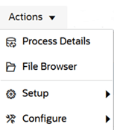
The Data Integration home page has undergone a subtle but powerful transformation. The familiar Actions menu has been reorganized into two new dropdowns: Setup and Configure.

The Setup menu is where you define the structure of your data environment. Think of it as mapping your maze before you start running:

  • Applications: Define your integration targets and sources.
  • Locations: Create and maintain locations for mapping.
  • Period Mapping: Align time-based data across systems.
  • Category Mapping: Manage application scenarios.
  • Query: Setup and modify data source queries.

Once your maze is mapped, it’s time to optimize your tools and security. This is where the Configure menu comes in:

  • System Settings: Control the behavior of your integration engine.
  • Security Settings: Safeguard access and permissions.
  • Agent: Manage the EPM Integration Agent settings.
  • Download Agent: Get the EPM Integration Agent software.

Just like the characters in Who Moved My Cheese? learned to adapt to their new reality, this menu redesign helps users adapt to their data environment more efficiently. By grouping actions based on context, users can find what they need faster and act with greater confidence eventually. Those of us who have switched to using the Data Integration UI will take a little bit to get used to it, but I think this is a small quality of life change that we will come to appreciate.

This update applies across business processes including Account Reconciliation, Planning, Tax Reporting, and more.

In the end, the cheese will always move. The question is: will you move with it?

EDM 25.09 Update – Request Monitoring Dashboard

In the September 2025 udpate (25.09), Oracle is adding a Request Monitoring Dashboard to EDM! Designed to enhance visibility and control over change requests, this dashboard empowers administrators, data stewards, and integration leads to streamline workflows and improve data quality across the enterprise.

The Request Monitoring Dashboard is a centralized interface that allows users to track and analyze open requests throughout their lifecycle. Whether you’re managing metadata changes, hierarchy updates, or complex multi-domain governance processes, this dashboard offers real-time insights into request activity, aging, bottlenecks, and contributor performance.

Key Features:

  • Lifecycle Tracking: Monitor requests by type, priority, workflow stage, and assigned contributors.
  • Custom Filters: Apply and save filters to focus on specific request attributes.
  • Dashboards:
    • Open Requests: View volume and distribution.
    • Active Owners: Identify who’s driving change.
    • Aging and Exceptions: Spot delays and anomalies.
  • Drilldowns & Drill-Across: Dive deep into request details or pivot to related metrics.
  • Export Capability: Download request activity for offline analysis or stakeholder sharing.
Request Monitoring Dashboard displaying open requests, active owners, aging, and exceptions. Features include request count by stage, open request distribution by application, and a snapshot of outstanding requests.
Sample Request Monitoring Dashboard image courtesy of Oracle

Why It Matters:

Managing change requests efficiently is critical to maintaining data integrity and operational agility. The dashboard helps teams:

  • Reduce request cycle time
  • Identify and resolve workflow bottlenecks
  • Improve exception handling
  • Enhance collaboration across business units

The Request Monitoring Dashboard isn’t just a new feature—it’s a strategic tool for proactive governance. By surfacing actionable insights and enabling smarter oversight, the Oracle EDM dev team continues to raise the bar for enterprise data management.

To find out more about this release, see the August 21 Oracle EPM Event by Rahul Kamath and Matt Lontchar here: https://community.oracle.com/customerconnect/events/606792-epm-whats-new-and-whats-coming-in-oracle-enterprise-data-management-edm-cloud

The EDM 25.09 features list can be found here: https://docs.oracle.com/en/cloud/saas/readiness/epm/2025/edm-sep25/25sep-edmcs-wn-f40991.htm

EPM Cloud 25.08 Updates – TLS, JRE, ARC Pipelines, Oh My

The EPM updates for 25.08 were released and we have an update to the TLS changes. Oracle has decided to continue supporting TLS 1.2 indefinitely, but only with ciphers deemed to be strong. The extension of support for TLS 1.2 gives Oracle and its customers a welcome bit of flexibility. Oracle has also released a document on how to test with the latest TLS ciphers document here: https://docs.oracle.com/en/cloud/saas/enterprise-performance-management-common/tsepm/cloud_epm_test_tls_ciphers.html

EPM Automate is switching to Java 17 instead of Java 8. Windows users rejoice! With the EPM Automate “update” command, EPM Automate will download and install the Java 17 runtime environment as part of the update process. Linux/Unix and Mac users will need to update their user-installed Java version to continue using EPM Automate 25.08 and after. Java 8 was released over ten years ago, so it’s good to see a newer version is being implemented. Linux/UNIX/Mac OSx users can go here to find how to update their Java version: https://docs.oracle.com/en/cloud/saas/enterprise-performance-management-common/cepma/installing_epm_automate_linux_unix.html

Account Reconciliation Cloud is getting Data Integration Pipelines with this update. Pipelines will be available on ARC pods with the following job types:

  • Create Reconciliation
  • Generate Report for Account Reconciliation
  • Import Attribute Values
  • Import Balances
  • Import Pre-Mapped Balances
  • Import Pre-Mapped Transactions
  • Import Rates
  • Run Auto Match
  • Run Auto Alert
  • Set Period Status

This should mean that we can define ARC jobs on any EPM Data Integration Pipeline and cross pods (similar to how we can run EDM exports across pods with Pipeline).

Before we go, I just wanted to take a moment to celebrate the deprecation of the Data Management/Data Integration job schedules. If anyone out there has braved the pain of that scheduler, those scheduled jobs need to be converted to the EPM Platform Job Scheduler before the 25.09 update. There is a System Maintenance Task job in Data Management called “Migrate Schedules to Platform Job Scheduler” to help with that effort. The EPM Job Scheduler isn’t available in PCM and ARC, unfortunately. If you use either of these business processes, scheduling outside using EPM Automate or rest calls is probably your best bet (and likely what most other customers are using anyways).

Oracle EPM AI features deliver on promises from long ago

I have accepted the fact that I am getting old (or is it “more experienced”?). At this point, I have been working on and around Oracle EPM products for almost twenty years. In the early 2000s, I was getting data from Hyperion Enterprise before we installed Essbase to do reporting. I dove into Essbase and began learning as much as I could. Once I reached a point where I felt I had done everything I could at my position as an administrator, I moved into consulting in 2010 to continue developing myself and learning more. As part of that, I took some training on OBIEE to help support customers with BI installs.

My point is, for 15+ years (maybe 20) EPM and BI users have heard about the promise of self-service BI: empowering users to analyze and visualize data independently. I remember hearing this in my OBIEE training and it was exciting to think about users digging into the data to answer business questions.

The thing with BI products is that there has to be someone technical to connect all of the data sources on the back end. It takes a special someone to figure out the right strings to pull to get all of those data sources normalized and linked up so that end users can do their reporting and analysis. It may be my bias as an implementer, but I don’t know how far users go past the initial dashboards that get created. I certainly hope it’s more common than I have seen.

As I sat in the Kscope Sunday Symposium presentations by Oracle product management and heard about all of the AI features coming to Oracle EPM, it dawned on me that all of the amazing things that I imagined 15 years ago will soon be possible and more accessible than ever. Users will soon be able to to chat with the AI built into Oracle EPM products and get visualizations fed back to them. To recycle an old sales pitch, analysis at the speed of thought is about to be real.

I am looking forward to seeing the developments in Oracle EPM products and I’m excited to see what our customers do with them. You can find the current AI features available in Oracle EPM products here: https://docs.oracle.com/en/cloud/saas/fusion-ai/aiafl/epm-features-with-ai.html. That list is about to get much longer. These are exciting times we live in.